View on GitHub
Open this notebook in GitHub to run it yourself
Encode in angle
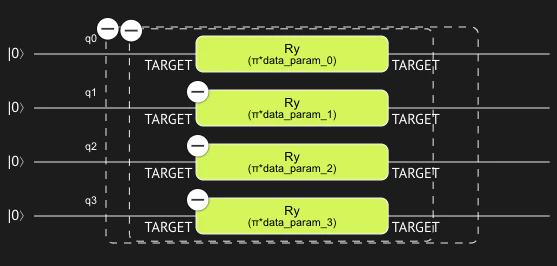
This function encodes data points on qubits, mapping the data point to a RY rotation on the -th qubit with a angle. Function:encode_in_angle
Arguments:
data:CArray[Creal]qba:Output[QArray[QBit]]
qba quantum argument is the quantum state on which we encode the classical array data.
Example
Encode on Bloch
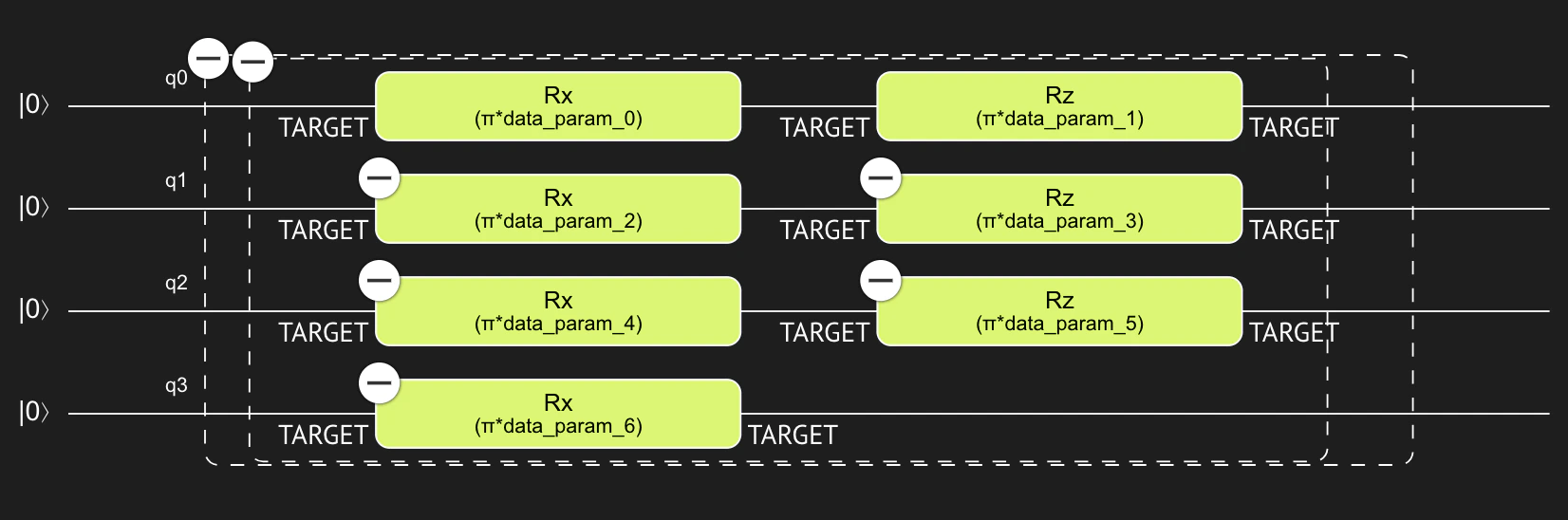
This function encodes data points on , mapping pairs of data points to the bloch sphere via RX rotation with an angle followed by a RZ rotation with an angle . If the number of data points is odd then a single RX rotation is applied to the last qubit, with an angle of . Function:encode_on_bloch
Arguments:
data:CArray[Creal]qba:Output[QArray[QBit]]
qba quantum argument is the quantum state on which we encode the classical array data.
Example